
Prospecting Skill [Beginner]
1. Define Sales Prospecting
Every successful business relies on a steady heartbeat of new opportunities. This heartbeat is prospecting, the active process of searching for and identifying potential customers. Without it, a sales engine eventually runs out of fuel, making it the essential lifeblood of growth.
Leads versus Prospects
In the world of sales, not every person you encounter is at the same stage. We start with leads, which are individuals or companies that have shown a glimmer of interest or fit a general criteria, like someone who downloaded a guide from your website. They are essentially 'raw data' that needs to be refined.
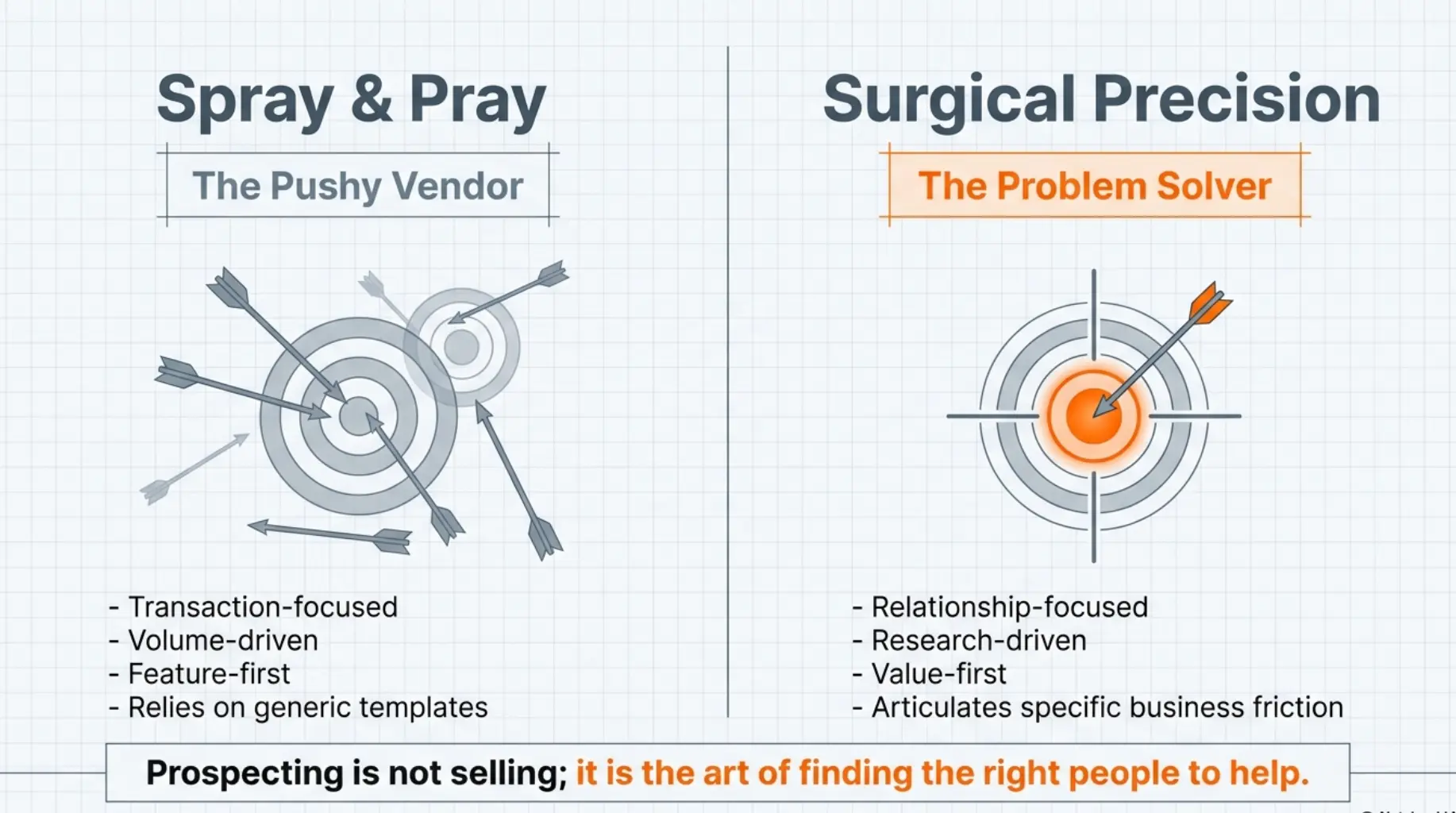
"At its core, sales prospecting is the process of finding, qualifying, and contacting potential customers to generate new business."
A lead becomes a prospect once you have qualified them. Qualification means confirming they have a problem you can solve and the means to pay for it. While a lead is just a name on a list, a prospect is a verified opportunity.
The Sales Pipeline
To visualize this journey, we use a sales pipeline. This is the path a stranger takes to become a client.
It helps you see exactly where each person is in their decision-making process.
Having a clear pipeline ensures that you don't lose track of people as they move from initial contact to a final agreement.
Starting with 300 prospects yields roughly 2 lead investors.
Massive top-of-funnel is required.
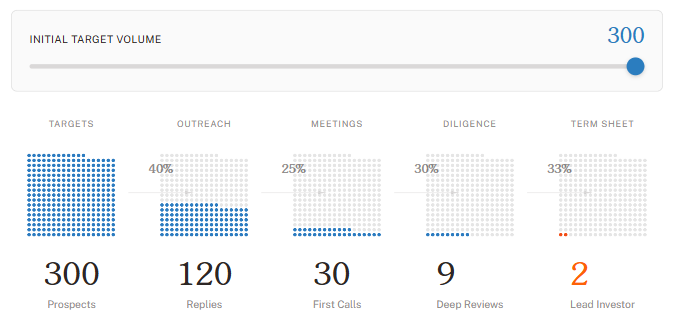
Think of the pipeline as a filter. Many people enter at the top as leads, but only a fraction move through each stage to become paying customers. This is why a constant flow of new people at the start is vital for consistent results at the end. To test your understanding, how would you describe the difference between a lead and a prospect?
2. Build Ideal Profiles
Before you send a single email or pick up the phone, you have to know exactly whose door you are knocking on. In sales, we call this defining your Ideal Customer Profile (ICP). It is essentially a description of the perfect company that would benefit from your product or service right now.
The Perfect Match: An Ideal Customer Profile (ICP) is a hypothetical description of the type of company that would realize the most value from your product.
It is not just about who might buy, but who should buy.
By focusing on these high-fit accounts, you avoid wasting time on leads that are likely to drop out or cancel early on.
This profile is usually based on firmographics like company size, industry, and location.
It also considers technographics, which is the specific technology stack a company already uses.
Ultimately, a strong ICP ensures that every minute your sales team spends prospecting is directed at the highest possible return on investment.
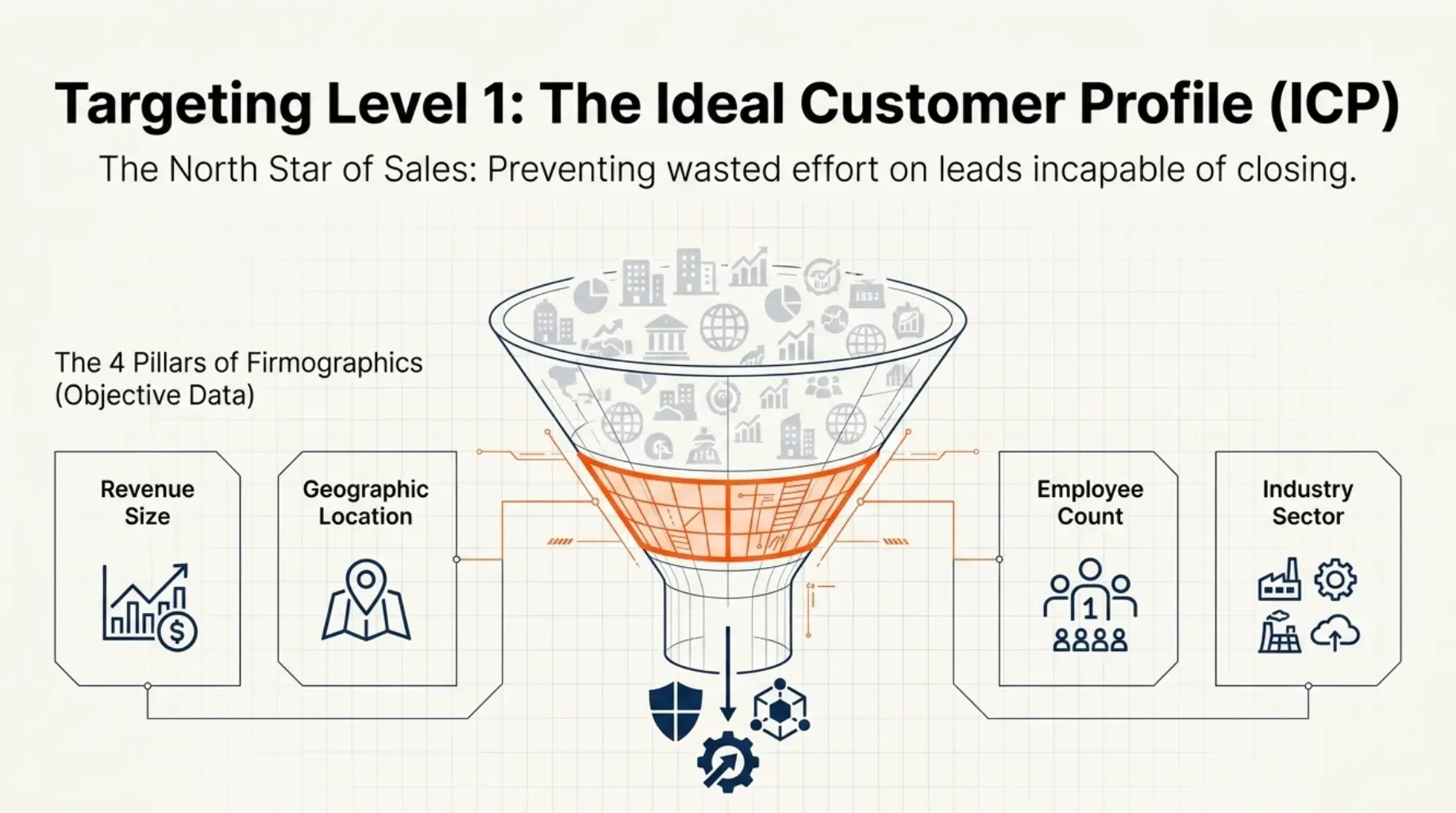
Think of prospecting like fishing. You could cast a wide net in the middle of the ocean and hope for the best, or you could find the specific 'pond' where your favorite kind of fish is known to hang out. Defining your ICP is how you find that pond.
The Three Pillars of an ICP
To build a sharp ICP, you generally look at three specific categories. These help you filter out the noise and focus on high-quality opportunities.
- Industry: What field do they play in? A software for hospitals is useless to a construction firm.
- Company Size: Are you looking for tiny startups or massive global corporations? The way they buy and the budget they have will be vastly different.
- Job Titles: Who is the actual human who feels the pain your product solves? This is your Economic Buyer or the person who can sign the check.
Finding Your Target
When these three pillars align, prospecting feels less like a cold chore and more like offering a solution to someone who is already looking for it. It makes your work easier because you are speaking the right language to the right people from the very first sentence.
Before we move on, let's make sure we have the core idea down.
3. Research Target Prospects
Once you know who your ideal customer is, the next step is finding where they live online and gathering clues that show they might need your help.
This process is like being a digital detective, using public tools to spot signals that a business is ready to change or grow.
You are looking for trigger events—specific occurrences like a new office opening, a round of funding, or a leadership change—that act as a green light for you to reach out.
Mining for Digital Clues
To start your search, use LinkedIn to see who has recently joined a company or been promoted. New leaders often want to make their mark and are more open to trying new solutions than someone who has been in the role for a decade. You can also use Google News to set up alerts for your target companies. This ensures you are the first to know about a new project or a quarterly earnings report that mentions a specific challenge they are facing.
When you browse a company website, look specifically at their 'Careers' or 'Join Our Team' page.
If a company is hiring heavily for a specific department, it tells you exactly where they are investing their resources and where they might be feeling growing pains.
By gathering these details, you move from making a generic pitch to having a specific, relevant conversation about their current reality.
4. Craft Value Messages
Effective prospecting starts with a fundamental shift in mindset: it is about solving, not just selling. Instead of leading with a generic list of features, successful outreach centers on the WIIFM principle, which asks, "What's in it for them?" By focusing on the prospect's specific challenges and goals from the very first word, you transform from a vendor looking for a paycheck into a trusted partner offering a solution.
Prospecting done right doesn’t feel like selling. It feels like solving.
To master this, your messages must be short and hyper-relevant. Avoid the temptation to drop a dense checklist of product capabilities. Instead, mention a specific pain point you discovered during your research and explain briefly how you can help alleviate it. This demonstrates that you have done your homework and respect their limited time.
When you lead with value, you earn the right to a conversation. Let's see if you can identify the core focus of a value-centered outreach message.
According to the 'What's In It For Them?' principle, what should be the primary focus of your initial outreach message?
5. Choose Outreach Channels
Every prospect has a preferred way to communicate. Some might spend their entire day in their inbox, while others prefer the quick back and forth of a LinkedIn message or the directness of a phone call. Picking the right channel is about meeting your audience where they are already comfortable.
The Multi Channel Edge
Relying on just one way to reach someone is like trying to open a locked door with a single key that might not fit. A multi channel approach uses a mix of email, phone, and social media to increase your chances of getting a response. It ensures that if they miss your email, they might still catch your voicemail or see your social notification.
"By using a mix of email, phone calls, and social media in your cadence, you dramatically improve the odds of reaching the prospect on the channel they’re most responsive to."
When deciding which channel to use first, consider the nature of your request. Email is great for sharing data or links that require time to review. The phone is best for urgent matters or when you need to build a quick human connection. Social media works best for 'warming up' a lead by commenting on their posts before you ever ask for a meeting. Since we have covered why a mix is better, let's see if you can identify the best tool for a specific situation.
6. Master Cold Calling
Cold calling is often the most nerve-wracking part of sales, but it becomes much easier when you stop viewing it as a performance and start seeing it as a conversation. The secret is to shift your focus: you aren't trying to close a massive deal in thirty seconds; you are simply trying to see if there is enough interest to justify a scheduled meeting later on.
The goal of a cold call is not to close a deal, but to secure a meeting.
To get there, you need to break the prospect's autopilot. Most people have a defensive 'not interested' reflex the moment they realize it's a sales call. You can bypass this by using a pattern interrupt, which is a way of starting the call that sounds different from the hundreds of robotic pitches they’ve heard before. Once you have their attention, you state your purpose clearly and ask a low-pressure question to gauge their openness to talking.
When you treat the call as a mutual discovery process rather than a one-way presentation, the intimidation factor fades away. Before we move on to the specific script structure, what would you say is the primary objective when you first pick up the phone to call a new prospect?