
Deal Closing Skills
— A Practical Roadmap From Beginner to Job-Ready Closer —
Prospecting → Qualification → Discovery → Business impact → Value case → Stakeholder alignment → Objection handling → Negotiation → Close → Implementation handoff
Your 70/30 split
30% theory: books, frameworks, videos, notes, sales psychology, methodology.
70% practice: role-plays, call recordings, discovery simulations, objection drills, negotiation simulations, CRM work, deal reviews, proposals, and capstones.
PHASE 0 — Sales Fundamentals
Objective: Understand what a sales process is, what a buying process is, and why deals stall. Build the vocabulary and operating discipline required for every later phase.
Prerequisites: None.
The psychology of buying
Why first: You need a mental model of the entire system before specializing in the final stage.
LEARN:
- Prospect vs. lead vs. opportunity
- Buyer vs. user vs. decision-maker vs. economic buyer
- Pipeline stages
- Qualification
- Sales cycle
- Win/loss
- ACV/ARR/TCV
- Conversion rate
- Sales velocity
- Forecast
What is a deal actually?
Why: Buyers rarely purchase solely because the salesperson's product is “good.”
LEARN:
- Pain vs preference
- Status quo bias
- Perceived risk
- Urgency
- Trust
- Decision friction
- Loss aversion
- Social proof
- Cost of inaction
Consultative vs transactional selling
Why: Buyers rarely purchase solely because the salesperson's product is “good.”
LEARN:
When the seller should diagnose, educate, recommend, or simply facilitate a purchase.
Sales process discipline
Opportunity-management training explicitly emphasizes moving opportunities through defined stages, logging activity, and ultimately recording closed-won/closed-lost outcomes.
LEARN:
- Stage exit criteria
- Next-step discipline
- Activity logging
- Follow-up
- CRM hygiene
- Forecast hygiene
Recommended resources
- Salesforce Trailhead — Sales Process Basics and Sales Calls
- HubSpot Academy — closing and asking-for-the-sale lessons
Books
- SPIN Selling — Neil Rackham
- The Challenger Sale — Matthew Dixon & Brent Adamson
- To Sell Is Human — Daniel Pink
Do not attempt to memorize every sales methodology.
Hands-on exercises
Create a fictional offer such as:
“A B2B SaaS platform that reduces customer support ticket volume.”
Then write:
- ICP
- Buyer
- User
- Typical pain
- Business impact
- Buying trigger
- Common alternatives
- Likely objections
- Reasons to delay
- What “closed won” would actually require
Then map ten fictional opportunities through a pipeline.
Common mistakes to avoid:
- Studying closing scripts before learning discovery.
- Confusing activity with progress.
- Treating CRM updates as administrative busywork.
- Assuming every prospect deserves equal effort.
- Thinking “relationship building” means being friendly without uncovering business value.
PHASE 01— Qualification and Discovery
Objective: Become capable of running a conversation that uncovers business pain, consequences, desired outcomes, decision dynamics, and urgency.
This is the most important phase because weak discovery creates nearly every downstream closing problem.
Current sales roles consistently emphasize consultative discovery and connecting business pain to outcomes rather than merely demonstrating features.
Prerequisites: Phase 0.
Active listening
Why first: A counselor cannot solve a problem they don't understand.
LEARN:
- Listening for facts
- Listening for emotion
- Listening for contradictions
- Summarizing
- Clarifying
- Reflecting
- Not interrupting
Question architecture
Learn to move through:
Context → Problem → Consequence → Desired outcome → Decision
Use questions such as:
- “How are you handling this today?”
- “What's not working?”
- “How often does that happen?”
- “What does that cost you?”
- “Who else is affected?”
- “What happens if nothing changes?”
- “What would improvement look like?”
- “How will you evaluate alternatives?”
Qualification
Learn to determine:
- Fit
- Need
- Business impact
- Authority
- Timing
- Budget/economic reality
- Decision process
- Competition
- Internal priority
MEDDPICC
Once basic discovery is comfortable, learn MEDDPICC, not before. The MEDDPICC framework currently covers:
- Metrics
- Economic Buyer
- Decision Criteria
- Decision Process
- Paper Process
- Implicate Pain
- Champion
- Competition
It is especially relevant to complex mid-market and enterprise B2B selling.
Why MEDDPICC comes here
It should be used as a deal diagnosis framework, not a checklist you mechanically interrogate prospects with.
Recommended resources
- MEDDICC's official methodology material
- HubSpot Academy closing and sales lessons
- SPIN Selling
- The Challenger Sale
Practice
Run 20 discovery role-plays.
Make each prospect different:
- Curious but unmotivated
- Price-sensitive
- Happy with current provider
- Has a serious operational problem
- Needs consensus
- Has no budget
- Has a deadline
- Is gathering quotes
- Wants a demo immediately
- Says “just send me pricing”
After every role-play, answer:
Could I identify:
- Pain?
- Business impact?
- Urgency?
- Decision-maker?
- Decision criteria?
- Process?
- Competition?
- Next step?
Common mistakes to avoid:
- “Tell me about your company” with no direction.
- Asking 30 questions like an interrogation.
- Pitching after the first pain statement.
- Asking “What's your budget?” too early without context.
- Treating MEDDPICC as a form rather than a thinking tool.
- Accepting “we're interested” as qualification.
PHASE 02 — Value Creation and Deal Control
Objective
Move from:
“The customer likes the product.”
to:
“The customer has a quantified business reason to change, and I know how the organization intends to buy.”
Prerequisites: Phase 1.
Pain → impact → value
Learn the chain:
Problem → operational consequence → financial consequence → strategic consequence → desired outcome
Example:
Slow sales follow-up
- → missed leads
- → lower conversion
- → lost revenue
- → slower growth
ROI and business cases
Learn:
- Cost savings
- Revenue uplift
- Productivity gains
- Risk reduction
- Payback period
- ROI
- Cost of inaction
Do not overstate precision. A credible estimate is better than a fabricated “exact” ROI.
Value messaging
Learn to communicate:
- Current state
- Desired state
- Gap
- Economic impact
- Why change
- Why now
- Why your solution
Salesforce's current material recommends tailoring presentations to customer needs and focusing on solutions rather than feature dumping.
Executive communication
Practice explaining the same deal to:
- User
- Manager
- CFO
- CEO
- Procurement
- Technical stakeholder
Mutual action plans / close plans
Learn to define:
- Buyer milestones
- Seller actions
- Owner
- Date
- Dependencies
- Risks
- Contract steps
- Implementation target
Current enterprise sales roles explicitly call for managing mutual action plans, complex buying processes, close plans, and cross-functional coordination.
Hands-on Exercises
Take five fictional customers and calculate:
- Current annual cost of the problem
- Potential annual value
- Implementation cost
- Payback
- Expected ROI
Then present each in:
- 30 seconds
- 2 minutes
- 10 minutes
Common mistakes to avoid:
- Fake ROI.
- Feature-to-benefit word salads.
- Generic decks.
- Calling every stakeholder a “decision-maker.”
- Treating the customer's verbal enthusiasm as a commitment.
- Leaving implementation/procurement until the end.
PHASE 03 — Objection handling and closing
Objective: Learn to handle resistance without becoming defensive, discounting too early, or using manipulative “closing tricks.”
Prerequisites: Phases 1–2.
Objection Diagnosis
Separate:
- Misunderstanding
- Lack of value
- Lack of trust
- Lack of urgency
- Risk
- Price
- Authority
- Timing
- Competition
- No decision
Clarification
Learn to respond:
“When you say it's too expensive, compared with what?”
Rather than immediately defending price.
Reframing
Connect objections to previously established buyer priorities.
Trial Closes
Examples:
- “How does that compare with what you were hoping to achieve?”
- “Assuming we solve that issue, is there anything else preventing you from moving forward?”
Direct Closes
Be able to ask clearly:
“Are you comfortable moving forward?”
or:
“What would need to happen for us to get this signed this month?”
Closing on implementation
The goal is not merely “yes.”
The goal is:
Yes → who → what → when → paperwork → implementation
Common Mistakes to Avoid.
- Feature dumping when objections appear.
- Talking faster because you're nervous.
- Discounting to escape discomfort.
- Asking “What would it take to close today?” when the buyer is not qualified.
- Fake scarcity.
- Manipulative pressure.
- Assuming every objection is a negotiation.
PHASE 04 — Negotiation and Commercial execution
Objective: Become capable of reaching agreement while protecting value, margin, and relationship quality.
Harvard's Program on Negotiation currently emphasizes difficult conversations, negotiation strategy, biases, competitive/cooperative strategies, and intensive simulations.
Prerequisites: Phases 1–3.
Negotiation fundamentals
LEARN:
- BATNA
- Reservation point
- Target
- ZOPA
- Leverage
- Alternatives
- Interests vs positions
- Objective criteria
Give-and-get negotiation
Never think:
“What discount can I give?”
Think:
“What am I willing to exchange for what I receive?”
Salesforce's current negotiation guidance explicitly recommends planning concessions and balancing what you give against what you get.
Commercial variables
Learn to negotiate:
- Price
- Term
- Volume
- Payment terms
- Start date
- Scope
- Support
- SLA
- Implementation
- Renewal
- Expansion
- Reference rights
- Contract length
Salesforce describes these variables as “deal dials” that can be adjusted as part of a holistic negotiation.
Tactical empathy and calibrated questions
Study:
- Labels
- Mirrors
- Summaries
- Calibrated questions
- Accusation audits
- Strategic silence
Black Swan's current negotiation material emphasizes listening, labels, mirrors, summaries, and calibrated questions as information-gathering tools rather than merely persuasive tricks.
Procurement negotiation
Learn to identify:
- Genuine commercial issue
- Procurement tactic
- Legal issue
- Budget constraint
- Vendor comparison
- End-of-quarter pressure
Common mistakes TO AVOID
Negotiating against yourself.
Discounting before value is established.
One-variable negotiation.
Giving without getting.
Revealing your minimum too early.
Treating silence as failure.
Treating procurement as the enemy.
PHASE 05 — Complex and enterprise deal closing
Objective
Move beyond one-to-one selling into multi-stakeholder deal strategy.
This is where closing becomes less about a single conversation and more about managing a system.
Current enterprise AE postings commonly expect multi-threading, executive engagement, procurement/legal navigation, accurate forecasting, and complex deal-cycle management.
Prerequisites: Phases 1–4.
Buying committees
Map:
- User
- Champion
- Manager
- Economic buyer
- Technical evaluator
- Procurement
- Legal
- Security
- Finance
- Executive sponsor
Champion development
Learn to determine whether someone is actually willing and able to help you internally—or merely likes the product.
Multi-threading
Build relationships with multiple stakeholders rather than betting the deal on one contact.
Decision process
Understand:
- Who recommends?
- Who approves?
- Who signs?
- What happens first?
- What happens next?
- What can stop the deal?
- What happens if the deadline slips?
MEDDPICC's Decision Process and Paper Process are especially useful here.
Competitive strategy
Competition means more than another vendor.
Your competition can be:
- Internal build
- Existing vendor
- Status quo
- Spreadsheet
- “Do nothing”
- Budget allocated elsewhere
MEDDPICC explicitly treats these alternatives as part of competition analysis.
Forecasting
Learn to classify:
- Pipeline
- Upside
- Commit
- Closed won
- Closed lost
Then defend your forecast using evidence rather than optimism.
Deal inspection
For every late-stage deal, ask:
“What evidence tells me this will close?”
not:
“Does it feel good?”
Common mistakes to avoid
→ Single-threaded deals.
→ Ignoring legal/procurement until the end.
→ Confusing seniority with buying authority.
→ Assuming a champion can sign.
→ Forecasting because the customer “said yes.”
→ Treating the competitor as the only threat.
PHASE 06 — Capstone and professional readiness
Objective
Demonstrate that you can run a complete deal rather than perform isolated sales exercises.
The capstone: Choose one realistic product/service.
A good choice is a B2B offer with:
- Meaningful price
- Multiple stakeholders
- Measurable ROI
- Some implementation complexity
- At least two plausible alternatives
Capstone scenario
You receive a target account. You must complete:
1. Account research
2. ICP assessment
3. Outreach hypothesis
4. Discovery plan
5. Discovery call
6. Qualification
7. MEDDPICC analysis
8. Solution recommendation
9. Business case
10. Executive presentation
11. Objection handling
12. Commercial proposal
13. Negotiation
14. Mutual action plan
15. Contract / paper-process simulation
16. Close
17. Handoff plan
---
FINAL EVIDENCE PACK
Create a professional portfolio containing:
- Account plan
- Discovery framework
- Call recording
- Call transcript
- MEDDPICC scorecard
- ROI calculator
- Executive summary
- Proposal
- Negotiation plan
- Mutual action plan
- CRM screenshots
- Forecast
- Deal post-mortem
This is far stronger evidence than a certificate alone.
Spaced repetition system
Use Anki, RemNote, or a similar tool. Create cards around:
- Terms
- Frameworks
- Objections
- Questions
- Negotiation principles
- Deal-stage exit criteria
- Common buyer signals
- Mistakes you've personally made
But do not turn sales into flashcard memorization. Your real retention test is whether you can deploy the concept under conversational pressure.
Beginner → intermediate → advanced progression
Beginner: You can:
- Explain the sales process.
- Conduct basic discovery.
- Handle simple objections.
- Ask for a sale.
- Track opportunities.
Intermediate: You can:
- Quantify business pain.
- Run structured discovery.
- Build ROI cases.
- Multi-thread.
- Negotiate basic commercial terms.
- Forecast with evidence.
Advanced: You can:
- Influence buying criteria.
- Build champions.
- Navigate complex buying committees.
- Shape competitive deals.
- Protect price.
- Diagnose stalled opportunities.
- Lead executive conversations.
- Forecast accurately.
- Structure complex commercial agreements.
Expert-level: Not a realistic six-month endpoint.
It requires repeated exposure to:
- Large contracts
- Executive buyers
- Competitive displacement
- Difficult negotiations
- Lost deals
- Political buying environments
- Unusual procurement scenarios
- High-stakes commercial tradeoffs
Practical tools and technologies
Essential
CRM
- HubSpot
- Salesforce
You need to be able to maintain opportunities, contacts, activity, next steps, and forecasting. Current AE roles frequently list CRM proficiency and forecast/pipeline discipline as core requirements.
Spreadsheet
- Excel or Google Sheets
For:
- ROI
- Pricing
- Pipeline analysis
- Forecasting
- Deal economics
Recording
- Zoom
- Google Meet
- Loom
For reviewing your own calls.
Documentation
- Google Docs / Notion
For:
- Deal plans
- Call plans
- Battlecards
- Objection libraries
Useful later
- Gong
- Salesloft
- Outreach
- Apollo
- LinkedIn Sales Navigator
- PandaDoc / DocuSign
- BI dashboards
Optional
- SQL
- Advanced CRM automation
- Python
- Advanced data analysis
- Marketing automation
These are useful in some sales operations or technical-sales paths, but they are not prerequisites for becoming a strong closer.
Topics to Avoid
Topics you should NOT spend much time on initially.
Do not spend your first 100 hours on:
Closing gimmicks
“Always be closing,” artificial urgency, and clever one-liners will not rescue weak discovery.
Memorizing scripts
You want conversational flexibility, not recitation.
Advanced enterprise frameworks
Don't learn MEDDPICC before you know how to conduct basic discovery.
Complex negotiation theory
Basic BATNA/ZOPA and give-get discipline come first.
Presentation design
A beautiful deck cannot repair a weak business case.
Cold-email optimization
Useful, but not the central objective of deal-closing competence.
CRM customization
Learn to use CRM effectively; do not become an amateur CRM administrator.
Collecting certifications
A certificate without recorded evidence of performance is weak proof of closing ability.
Real-world workflows to practice
You should eventually be able to execute this workflow without a script:
Research account → identify hypothesis → plan discovery → run discovery → qualify → map stakeholders → quantify impact → build business case → align solution → identify objections → establish decision process → build mutual action plan → negotiate → manage procurement → close → hand off → review
That sequence closely resembles what current full-cycle AE jobs actually require.
Interview Preparation
Common interview questions.
Expect questions such as:
“Walk me through your sales process.”
Your answer should demonstrate stage logic, not slogans.
“How do you qualify an opportunity?”
Discuss fit, pain, value, authority, timing, process and competitive reality.
“Tell me about a difficult objection.”
Explain how you diagnosed it before responding.
“How do you negotiate price?”
Show value, variables, tradeoffs and give-get discipline.
“How do you know a deal is real?”
Talk about evidence: economic buyer, decision criteria, process, champion, timing, paper process, compelling business impact.
“Tell me about a deal you lost.”
Explain what you misdiagnosed and what changed afterward.
“How do you forecast?”
Tie the forecast to verifiable deal evidence, not optimism.
“How would you handle a prospect asking for a 20% discount?”
Explain what you would discover first and what you'd seek in return.
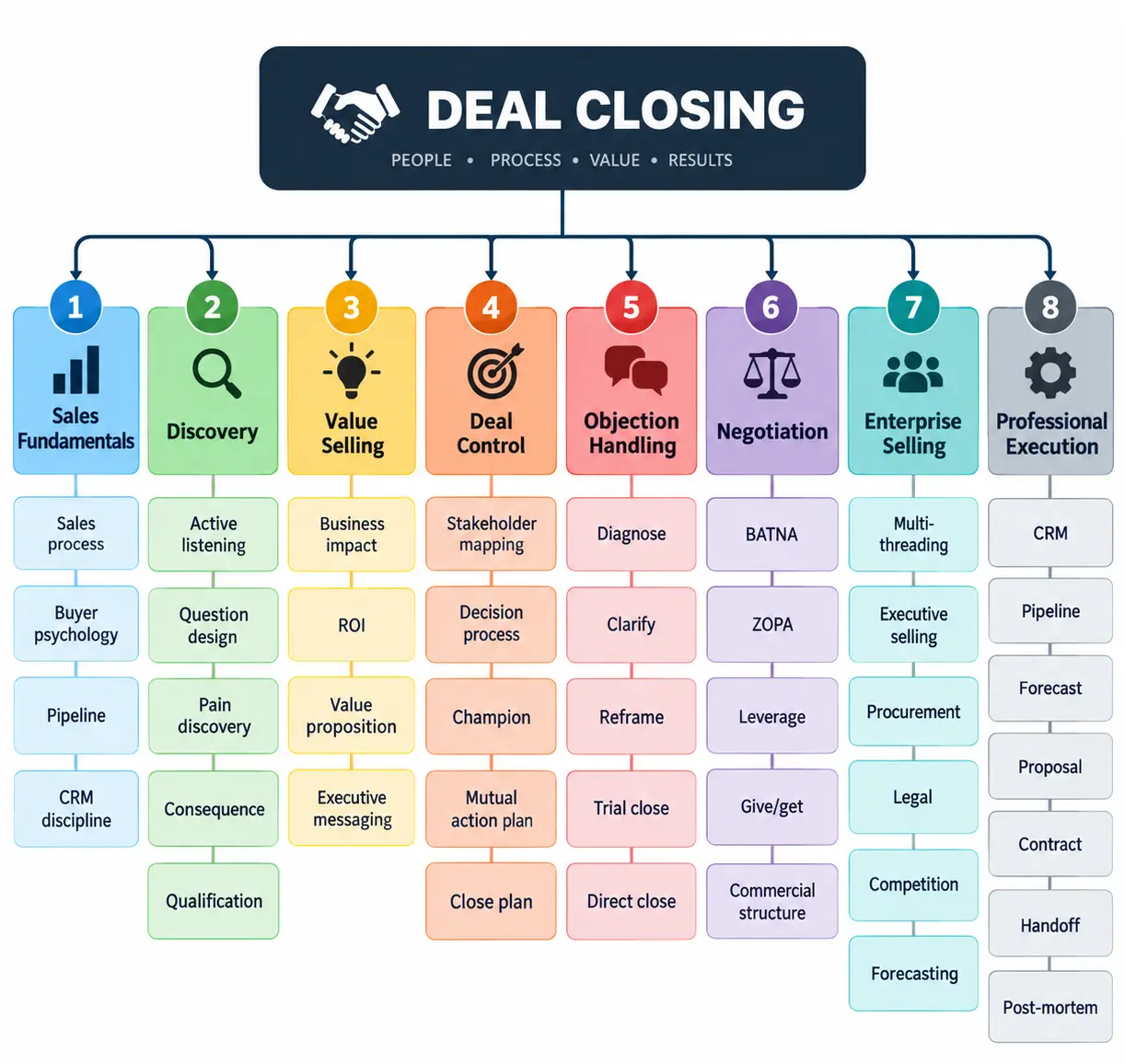
Job-Readiness Checklist
You are approaching job-ready when you can truthfully check most of these:
- I can run a 30-minute discovery without a script.
- I can distinguish symptom from business problem.
- I can quantify business impact.
- I can identify the economic buyer.
- I can map a buying committee.
- I can identify a genuine champion.
- I can map the decision process.
- I can explain the paper process.
- I can diagnose objections.
- I can ask for the sale directly.
- I can negotiate without reflexive discounting.
- I can create give/get trades.
- I can construct a basic ROI case.
- I can maintain a CRM accurately.
- I can explain and defend my forecast.
- I can prepare an executive-level business case.
- I can handle a skeptical stakeholder.
- I can run a multi-threaded deal.
- I can explain why a deal is likely to win or lose.
- I have recorded evidence of my performance.
- I have at least 3 substantial portfolio projects.
- I can conduct a complete capstone without prompts.
The most important rule is this:
You have not mastered deal closing when you can explain closing. You have mastered it when you can repeatedly diagnose, advance, negotiate and close a realistic opportunity under pressure.
Recommended Resource List
Start here
Salesforce Trailhead.
Use:
- Sales Process Basics
- Sales Calls
- Opportunity Management
- Sales Deal Structures
- Sales Contracts and Negotiation
These are practical, structured and currently maintained.
HubSpot Academy
Use:
- Learn Proven Sales Strategies to Close More Deals
- How to Ask for the Sale
These cover objection handling, expectations, closing questions and asking for the sale.
---
Methodologies
MEDDICC: Methodology material to understand Metrics, Economic Buyer, Decision Criteria, Decision Process, Paper Process, Pain, Champion and Competition.
Negotiation
Harvard Program on Negotiation: Use it for negotiation theory, difficult conversations and simulations.
Black Swan Group: Use its tactical-empathy and calibrated-question material for practical negotiation drills.
---
Books
Read in this order:
SPIN Selling — Neil Rackham
The Challenger Sale — Matthew Dixon & Brent Adamson
Never Split the Difference — Chris Voss
The Qualified Sales Leader — John McMahon
Gap Selling — Keenan
Do not read them passively. Every chapter should generate a role-play or real exercise.